
The Fire Inside
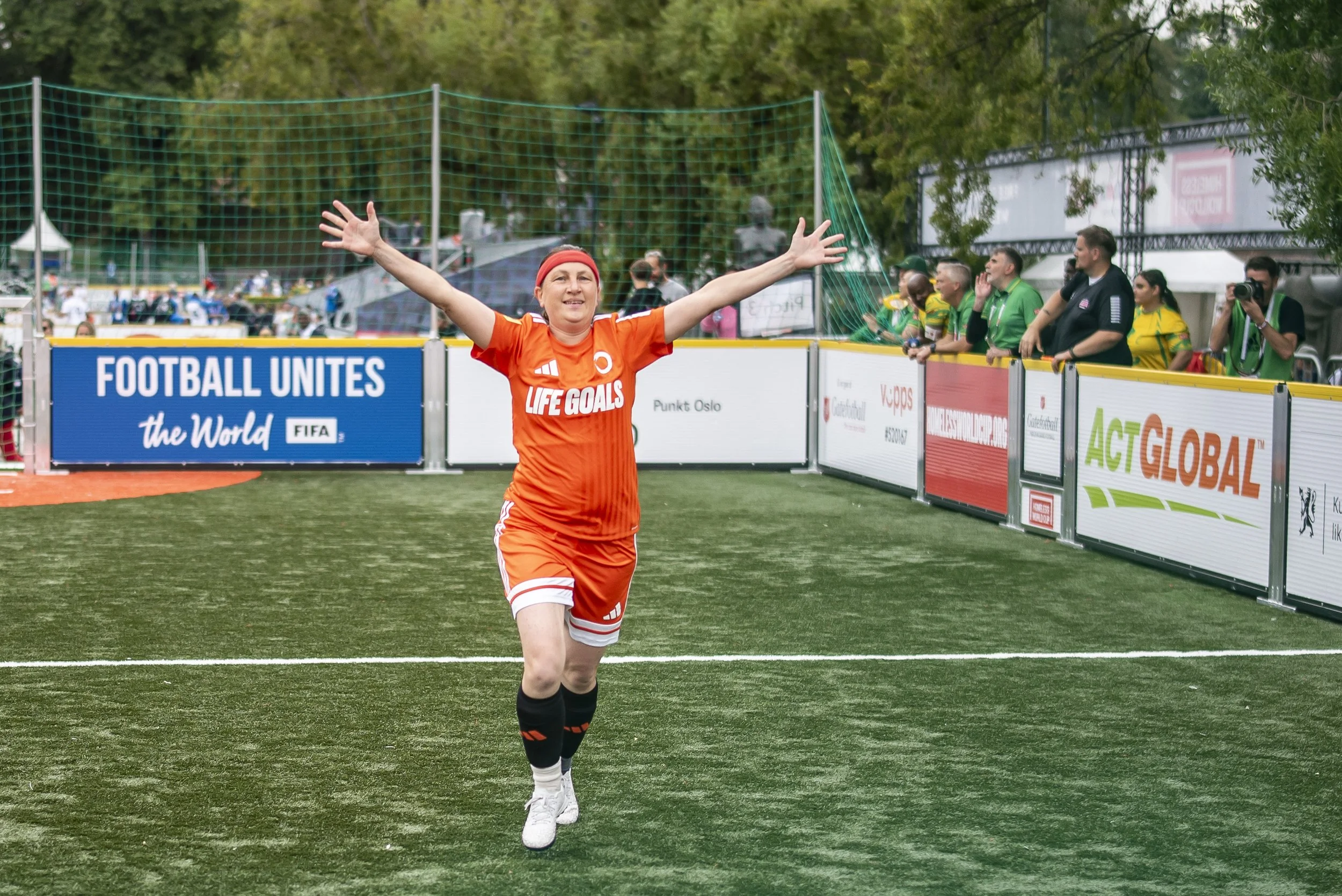
| Liesbeth represented the Netherlands at the Oslo 2025 Homeless World Cup with a mixed team that competed in the Men’s competition. Photo: Donnie Nicholson
[Trigger Warning: This article contains mentions of suicide and sexual abuse]
Standing tall and with an air of calm, Netherlands’ number seven Liesbeth steps up to take a penalty. The ball sails through the Mexican goalkeepers’ legs and hits the back of the net. She can’t believe it. She’s just scored for her country at the Homeless World Cup.
What followed, Liesbeth didn’t know how to explain – “something inside was exploding” -she wanted to laugh, to cry.
“I was so happy. I had never felt happiness so deeply.”
She was also hyperventilating.
Her gut reaction was to leave the pitch, but her team-mates made her stay.
A few months earlier, she’d been lost for words too, on a phone call with Dutch national coaches René and Jasper. They confirmed she had the final place on the national team, and she would be representing the Netherlands at the Oslo 2025 Homeless World Cup.
“I thought they were joking, I was crying, it was the best moment I’ve ever had. It still gets me when I talk about it.”
Visibly welling up as she remembers, you can feel the pride as she recalls that goal and many of the other 11 goals she scored during the week in the Norwegian capital. Her target of five goals in one day was reached on day three of the tournament and, from the moment she arrived, she was flying.
Something about football has always been special for Liesbeth.
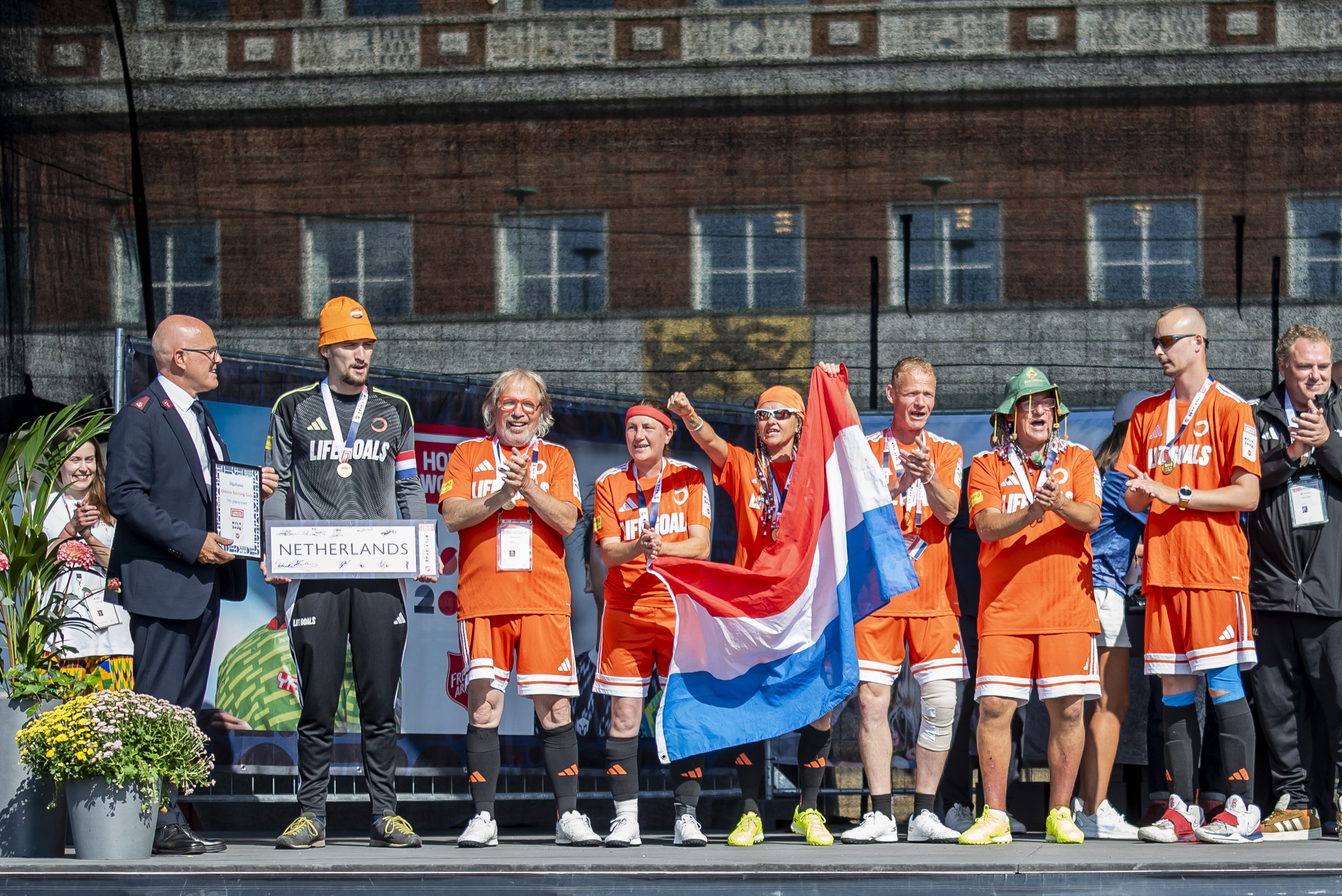
| The Netherlands recieving their participation medals at the Oslo 2025 Homeless World Cup. Photo: Donnie Nicholson
A traumatic childhood
“I had the hardest childhood experience that someone can have, but every time I saw the ball, it was like a flame.”
Growing up, home wasn’t a safe place for Liesbeth. She experienced severe neglect from the age of five. As a child she also suffered prolonged sexual abuse involving different perpetrators.
Her mother, who was struggling with her mental health at the time, turned Liesbeth into a target for both physical and emotional abuse with their dirty, cluttered, house a reflection of her mother’s hoarding disorder.
Football came as an escape.
As a child she drew goalposts on the garden wall and would spend hours scoring goals and dreaming of playing in a World Cup.
Football wasn’t her only escape, however – by 13, she’d become addicted to alcohol and was caught in a cycle of addiction.
Liesbeth has been sober since 2019 and says football played an important role in helping her to overcome addiction.
For a long time, Liesbeth was silent about what she had faced in her own life, quietly suppressing the horrors that surrounded her childhood.
“After my addiction was gone, I think everything I was pushing down in my body was coming out.”
“I had derealisation and de-personalisation disorder. I was lost. I was walking in a maze of glass, and I didn’t come out of it. Then a door opened and there was the trauma from my childhood.”
Once the door opened, it wouldn’t close; “It was 24/7 – I could only sleep two hours at any time.”
Liesbeth was taken to a trauma centre where she stayed for eight days. Over the following year, she was regularly in and out of hospital.
“I was in the mental health institute, and people were coming together and we would cook together. A lot of people committed suicide there. I was sitting on the couch thinking one day I will die. I had no goal in my life.”

| Liesbeth with Mazuita from the Australian team at the Oslo 2025 Homeless World Cup. Photo: Donnie Nicholson
It was in 2019, during her treatment, that Liesbeth met an old friend who recommended she go along to a Life Goals session. She smiles as she remembers cycling to her first football session and turning up in jeans.
Then the moment she stepped on the pitch, something changed.
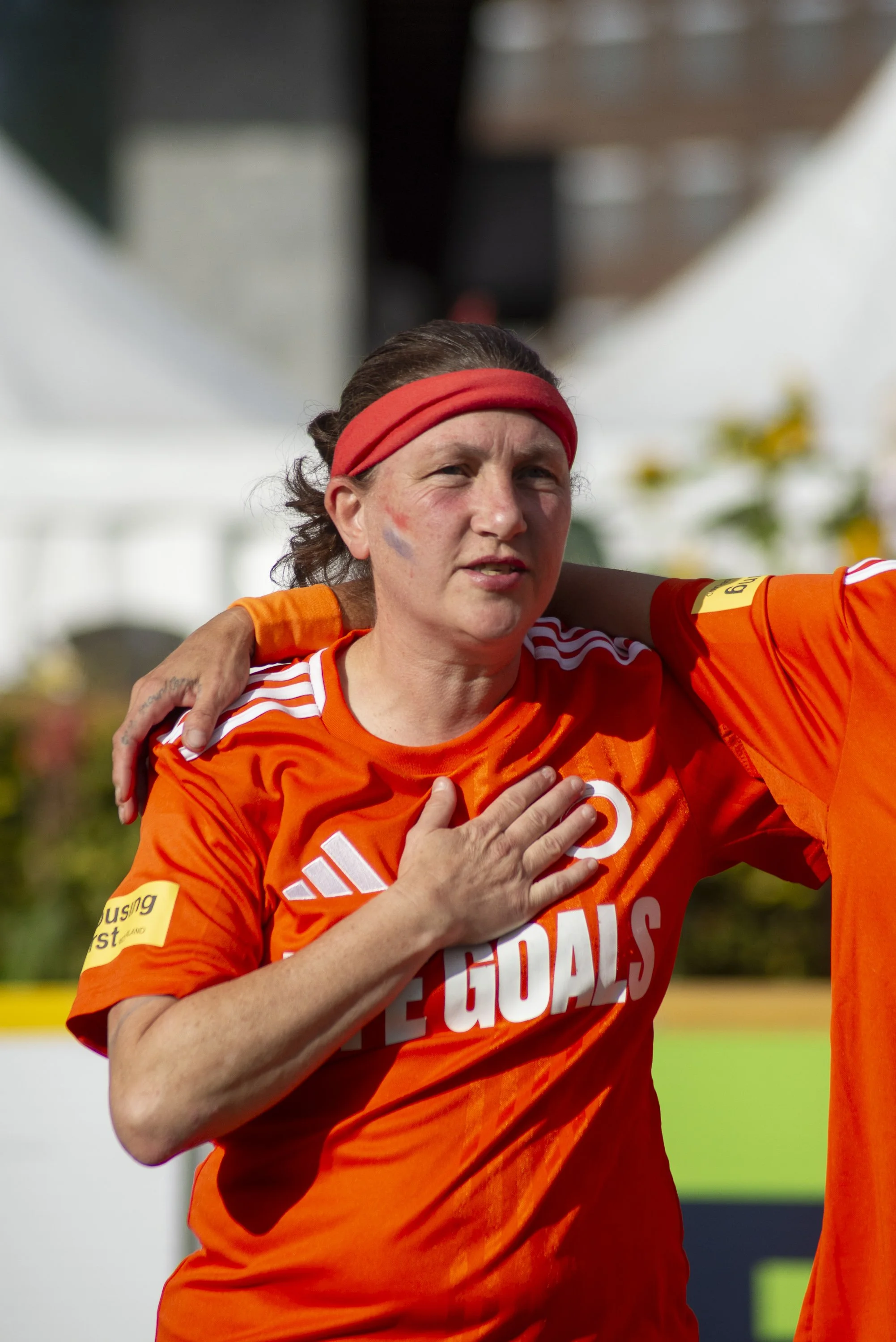
| “When I was on the pitch, everything was silent”.
Photo: Donnie Nicholson
“When I was playing, the movie in my head stopped. I was just focusing on the ball. When I was on the pitch, everything was silent.”
That silence gave her a chance to breathe and find a way out of the ‘glass maze’.
Quickly, Liesbeth became a regular at the sessions.
“I lived from Tuesday to Tuesday. The other days were surviving days before going to go and play soccer for one hour.”
However, Liesbeth faced further setbacks and trauma and in 2020, she was raped again.
She repeatedly fought for justice but insufficient evidence meant that none of her perpetrators, both from childhood or from 2020, were ever charged.
However, at the Homeless World Cup she found out that she would be awarded some financial compensation for what had happened, both to her as a child, and also for the attack in 2020.
“When it’s coming out it’s a relief, but it’s also very hard. I see many people in the same situation. Some people are at the beginning. Some people are out of it. I thought maybe if they can do it, I can do it also.”
“Two years ago, I had a lot of stress, I couldn’t handle it anymore. I wanted to commit suicide because life was very hard. But my focus was on the football. The football kept me here. I have a dream, I must go, I must go.
“I know there is life before mental health issues and I know there is life after it. I know it’s something you can come out of, and I believe in that, so my goal was to take everybody with me.”
“Life Goals gave me opportunity to feel that I matter. This has changed my life. I think if I didn’t join Life Goals, I think maybe I would be dead.”
Now Liesbeth is determined to show everyone that nothing will stop her. She has completed multiple training courses and education programmes – so many, that we tell her she must now be one of the most qualified people in the Netherlands!
“The more people say I can’t do it, the more I want to prove it. The flame inside was a little bit small, but sport put the wind in it and now it’s growing and growing.”
Stichting Life Goals represent The Netherlands at the Homeless World Cup. They work nationwide using sport to support people experiencing social isolation to rebuild their lives and reintegrate into society.
Football can be the first step for people to rebuild their confidence, find a sense of belonging, and can help people to rebuild their lives. The Homeless World Cup gives Liesbeth the unique opportunity of representing her country and being seen and celebrated. This becomes a turning point, showing that there is a route forward.
Help other people to change their lives and buy a seat in the Impact Stadium.
Every seat changes a life like Liesbeth’s.