
we use the power of football to change lives.
Our Vision is for a world without homelessness.
Our Mission is to use football to support and inspire people who are homeless to change their own lives; and to change perceptions and attitudes towards people who are experiencing homelessness.
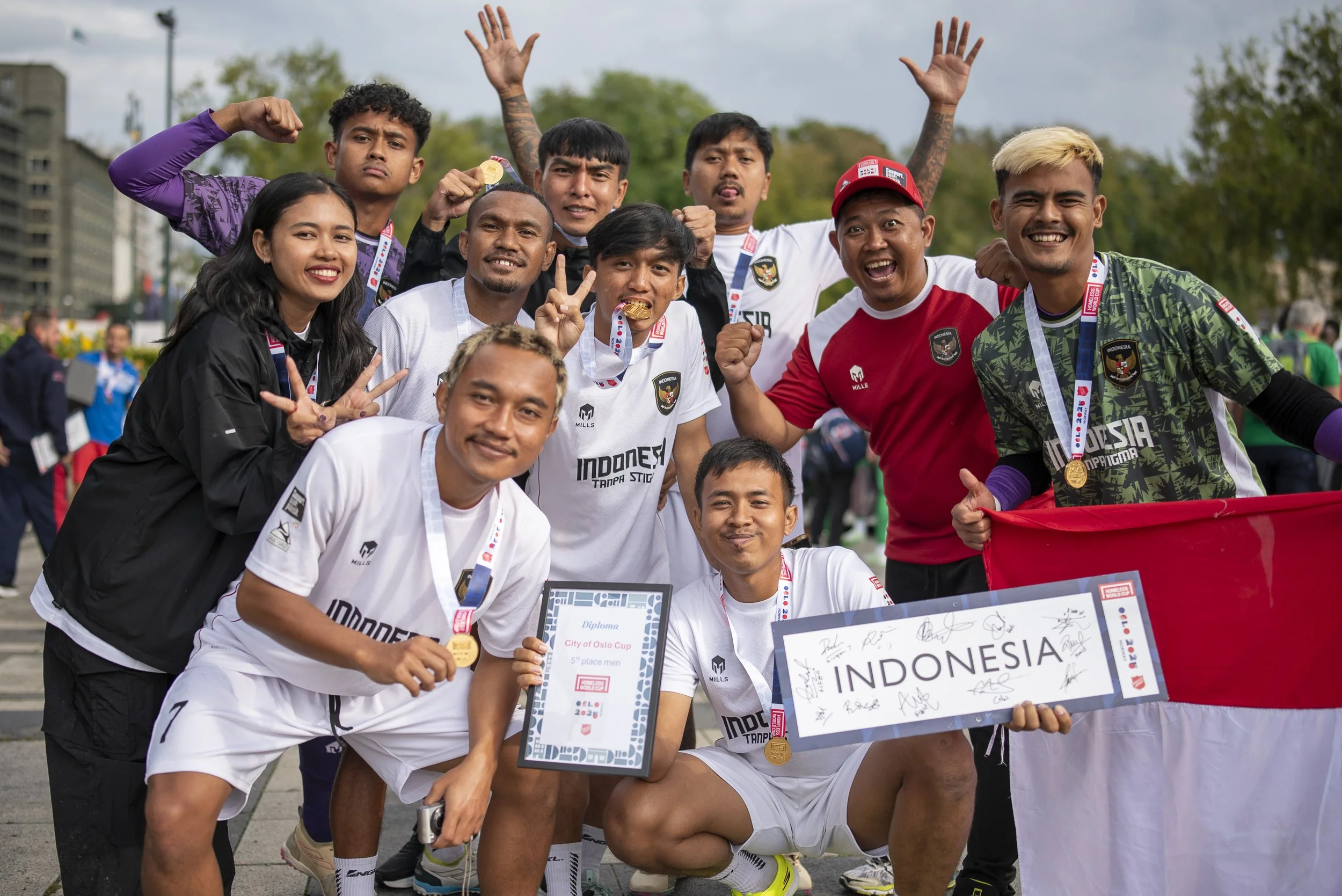
A global charity.
A year-round movement.
The Homeless World Cup Foundation is a global charity working with 75 Member Countries that use football to support people experiencing homelessness, social exclusion and isolation.
Together, we create opportunities for people to build confidence, find belonging and move forward with their lives. Our network connects grassroots organisations across the world, helping them share knowledge, strengthen their work and amplify the impact they create in their communities.
At the heart of the movement is the annual Homeless World Cup - a global celebration of the year-round work happening across our network.
For players, representing their country can be a life-changing moment of pride, connection and hope.
Our work goes far beyond the tournament.
Throughout the year, we support collaboration between Member Countries, share learning and give local organisations a stronger collective voice.
Through our Cities Ending Homelessness Forum, we also bring together city leaders, policymakers, researchers, practitioners and people with lived experience to share solutions and drive the conversation around ending homelessness.
Together, we are changing perceptions, strengthening communities and using football to help more people realise their potential.

Change through football
Experiencing homelessness can be deeply isolating, leaving people feeling disconnected, unseen and unsupported. Joining a football programme with one of our Member Countries may seem like a small step, but for many it is the beginning of something much bigger: a route back into community, confidence and connection.
Through football, people build relationships, take on responsibility and move from standing alone to becoming part of a team. Training sessions, matches and shared goals create structure, purpose and pride — a space where people are valued for who they are, rather than defined by their circumstances.
At the Homeless World Cup Foundation, we believe football can be a powerful catalyst for change. It creates equal footing, encourages teamwork and fair play, and helps people build positive relationships with coaches, volunteers, teammates and their wider community.
The journey does not end on the pitch. Through pathways into refereeing, coaching, volunteering and employment with our Member Countries, participants can develop skills, take on leadership roles and shape their own future.
The confidence and sense of belonging created through football can help people see that change is possible — for themselves, their families and their communities.
Across our global network of 75 Member Countries, we work year-round to strengthen local programmes, share knowledge and create opportunities for people to move forward. This work is celebrated through the annual Homeless World Cup tournament and strengthened through initiatives such as our Cities Ending Homelessness Forum.
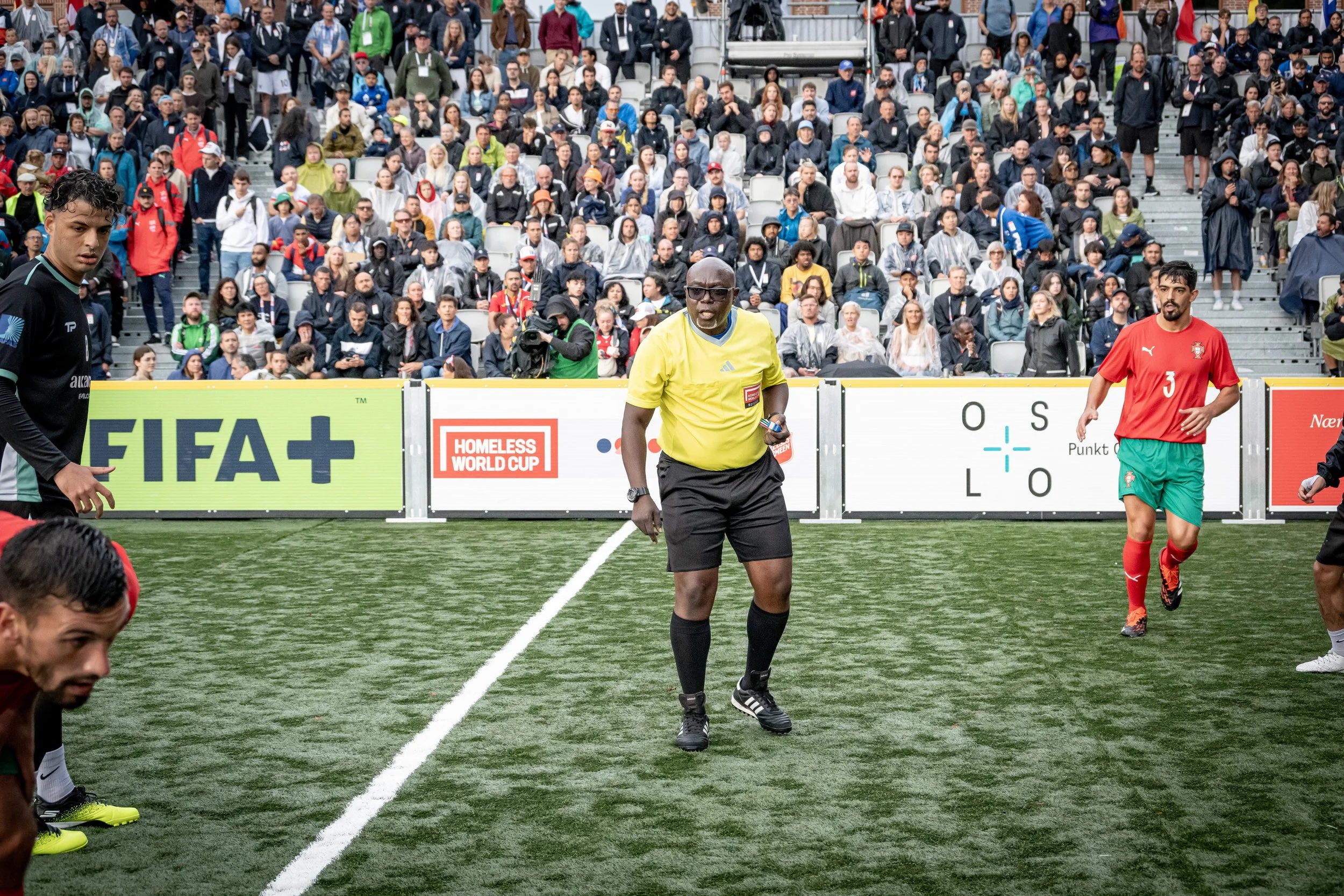
Ed Kiwa represented Canada as a player at the Mexico 2012 Homeless World Cup and then trained as a referee. He refereed the Oslo 2025 Homeless World Cup Men’s final.
Our Values
Our Values, outlined in our Homeless World Cup Charter, provide the foundation for our work at the Homeless World Cup Foundation and all our Homeless World Cup Member Countries, teams and players of our Global Network must adhere to them:
-
We know that homelessness manifests itself differently from country to country. There is no international definition for homelessness. Each country has a different definition which we respect. Some countries deny that they have any homelessness and we will campaign for them to recognise the problem. -
As an international language, football has the power to change lives. We use it as a tool to engage homeless and socially excluded people to participate in locally based development programmes, which all link to the wider international HWCF Network and the global movement. -
We believe in the concept of a hand up rather than a handout. Personal development programmes that ensure homeless people are at the centre of their own progress fosters a greater degree of self-determination to control one’s own life. -
We believe safeguarding must be prioritised to ensure participants are protected from harm, including all forms of exploitation, abuse and harassment. -
Both local partner and HWCF staff and volunteers are an integral part of the Network. We respect and value their support in every aspect of our work. -
We believe in fair play and designing competitions to be inclusive as well as competitive. We respect the rules of the game, the people who administer them and the players who participate. -
We believe strongly in diversity and equality and operate a non-exclusive and non- discriminatory programme that actively encourages individuals, regardless of sex, age, race, religion, disability and sexual orientation. -
Homelessness is different from ‘houselessness’. We believe in creating a sense of belonging wherever people are. -
We believe in creating an identity for the players through all our work. Within the Network, we create a dynamic space where players can share experiences with others from around the world and be proud to be part of a global constructive movement. -
We take environmental considerations seriously and work continuously to minimise our operational impact on the environment.
The Homeless World Cup Foundation is committed to recognising the human rights outlined in the International Bill of Human Rights and also the goals of the Paris Climate Change agreement, and specifically the outline of the United Nations Global Climate Action.
The Homeless World Cup Foundation is a charity registered in Scotland. Our Charity Number is SCO37091.
SUSTAINABLE DEVELOPMENT GOALS

Our work directly supports five United Nations Sustainable Development Goals (SDGs), reflecting the role sport can play in creating fairer, healthier and more inclusive cities.
Through football, the Homeless World Cup Foundation supports people experiencing homelessness to reconnect with housing, services and opportunity (SDG 1: No Poverty), while improving mental health, wellbeing and recovery through routine, purpose and community (SDG 3: Good Health and Well-being).
We promote equality and inclusion by ensuring parity between men’s and women’s competitions and actively working to grow women’s participation worldwide (SDG 5: Gender Equality). By amplifying lived experience and challenging exclusion, we reduce inequalities within countries (SDG 10: Reduced Inequalities).
Delivered through city-based, community-led networks, our work strengthens inclusive, resilient and sustainable cities (SDG 11: Sustainable Cities and Communities), demonstrating how football can be a powerful tool for lasting social change.

The Homeless World Cup is among more than 50 football organisations who have joined the Football for the Goals initiative.
Football for the Goals is run by the United Nations and brings together international organisations who are using football to tackle and raise awareness of the Sustainable Development Goals (SDGs).
At the Homeless World Cup Foundation, we believe in the importance of the SDGs and see sport as a key tool in bringing people together to create truly meaningful change.
Also, as a global event, we will continue to commit to being as sustainable as possible in our approaches.

In October 2022, the Homeless World Cup joined the UN’s “Football For the Goals” initiative
How we define homelessness
Homelessness takes many forms, has countless causes and affects people in profoundly different ways. Around the world, people experiencing homelessness face social exclusion and stigma, extreme poverty and significant physical and mental health challenges.
The Homeless World Cup Foundation exists to help end this crisis in all its forms - because everyone deserves a home. It is a fundamental human right, as stated in the United Nations Universal Declaration of Human Rights.
To better understand the scale and complexity of homelessness, we compile and analyse global homelessness statistics across our 70+ Member Countries.
Homelessness can manifest in many ways, from rough sleeping and temporary shelters to unsafe, insecure or inadequate housing and while the causes are diverse, they are often rooted in poverty, inequality, conflict, trauma and systemic barriers.
The forms listed below are not exhaustive but represent some of the most common experiences of homelessness worldwide.

Anyone can become homeless, but these particular groups are often at higher risk:
Those on low income.
In poverty-stricken countries.
Of a minority race.
LGBTQI+.
Living with HIV/AIDS and/or disabilities.
Fleeing war or natural disaster.
Seeking asylum.
Recovering from addiction, trauma or abuse.
Having spent time in state-sponsored institutions, including prisons, mental health support centres, youth care homes and the military.
-
People can be homeless in many different ways, and it has countless diverse causes – often linked to poverty.There is no international definition for homelessness. Each country has a different definition which we respect. Some countries deny that they have any homelessness and we will campaign for them to recognise the problem.
-
Homelessness is not the same as Houselessness’. Someone can be homeless while still having a roof over their head.When we talk about ‘insecure’ accommodation it can refer to structurally unsound properties, such as slum areas which are illegally built on flood plains. However it can also be ‘insecure’ in terms of unsustainable e.g., someone who is living on someone else’s sofa.
Defining homelessness is complicated, but getting an idea of what secure housing is can be done by answering these three questions:
Will someone be able to live there long-term? (We define this as more than 24 months)
Does the person living there have independence? (For example; Do they have agency over what food they eat? Or when they can come and go?)
And the most fundamental one, does it feel like their home?
You can read more about defining homelessness and the ETHOS definition of homelessness here.
-
This list is not exhaustive, but these are some of the most regularly seen examples of people living with homelessness.Anyone can become homeless, but these particular groups are often at higher risk:
• Those on low income/in poverty-stricken countries
• Of a minority race
• Members of the LGBTQI+ community
• People living with HIV/AIDS
• People living with disabilities
• Fleeing war or natural disasters
• Seeking asylum
• Recovering from addiction, trauma or abuse
• Having spent time in state-sponsored institutions including: prisons, mental health support centres, youth care homes and the military.