The Volunteer Team Behind the Stories from Oslo 2025
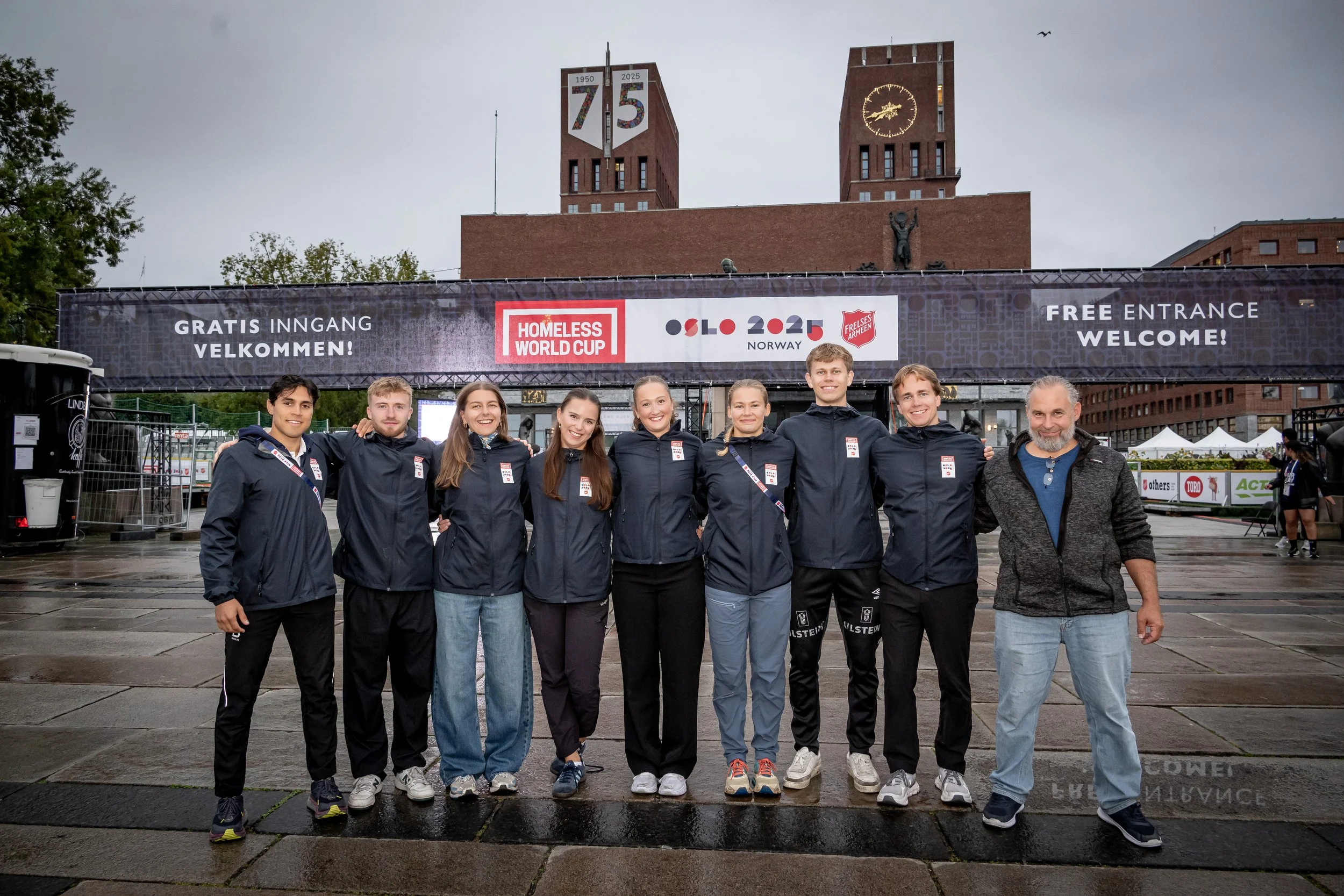
| “It’s a big honour. It’s been a huge experience” - Physiotherapy students with their lecturers at the Oslo 2025 Homeless World Cup. Image: Anita Milas
meet our volunteer physio team
At the Homeless World Cup all attention is, quite appropriately, focused on the players on the pitch. Their experience and wellbeing is, after all, the reason the tournament exists. But behind the scenes there’s a team experiencing the tournament in a complementary manner, and their involvement in the tournament’s is equally integral. That team is made up of Danish and Norwegian physiotherapy students providing expert care to enable the players to take (and continue taking) to the pitch tournament-long.
The nine students in the 2025 team: four Danish and five Norwegian, the latter the home team tipping the balance ever so slightly in their favour, heard about the work experience opportunity via their university courses. Applications were open to final-year physiotherapy students to spend a week gaining hands-on experience through a football tournament for people from around the world with lived experience of homelessness and marginalisation.
The students’ placements were overseen by experienced lecturers and organisers Nicolas Kjerulf and Kjell-Egil Bogfjellmo Haug, who have steered the Homeless World Cup physiotherapy program and students’ experiences through many tournaments over many years. The students also had some insight into what to expect work-wise, having had some earlier practice volunteering for their home countries’ national street football championships.
Still, it was an intense, immersive experience.
“The first couple of days, I was very overwhelmed by how big an event it was, and also how many players and countries there were,” Dorthe Bergestuen and Frederikke Jaeger Hurtigkal, two of the students, explain. But really, they say, “It’s a big honour. It’s been a huge experience.”
The week-long placement comprised morning and afternoon shifts, with peak periods including requests for remedial massage and taping. And for treating injuries, including some random injuries as rain left the pitches slippery.
| Image: Anita Milas
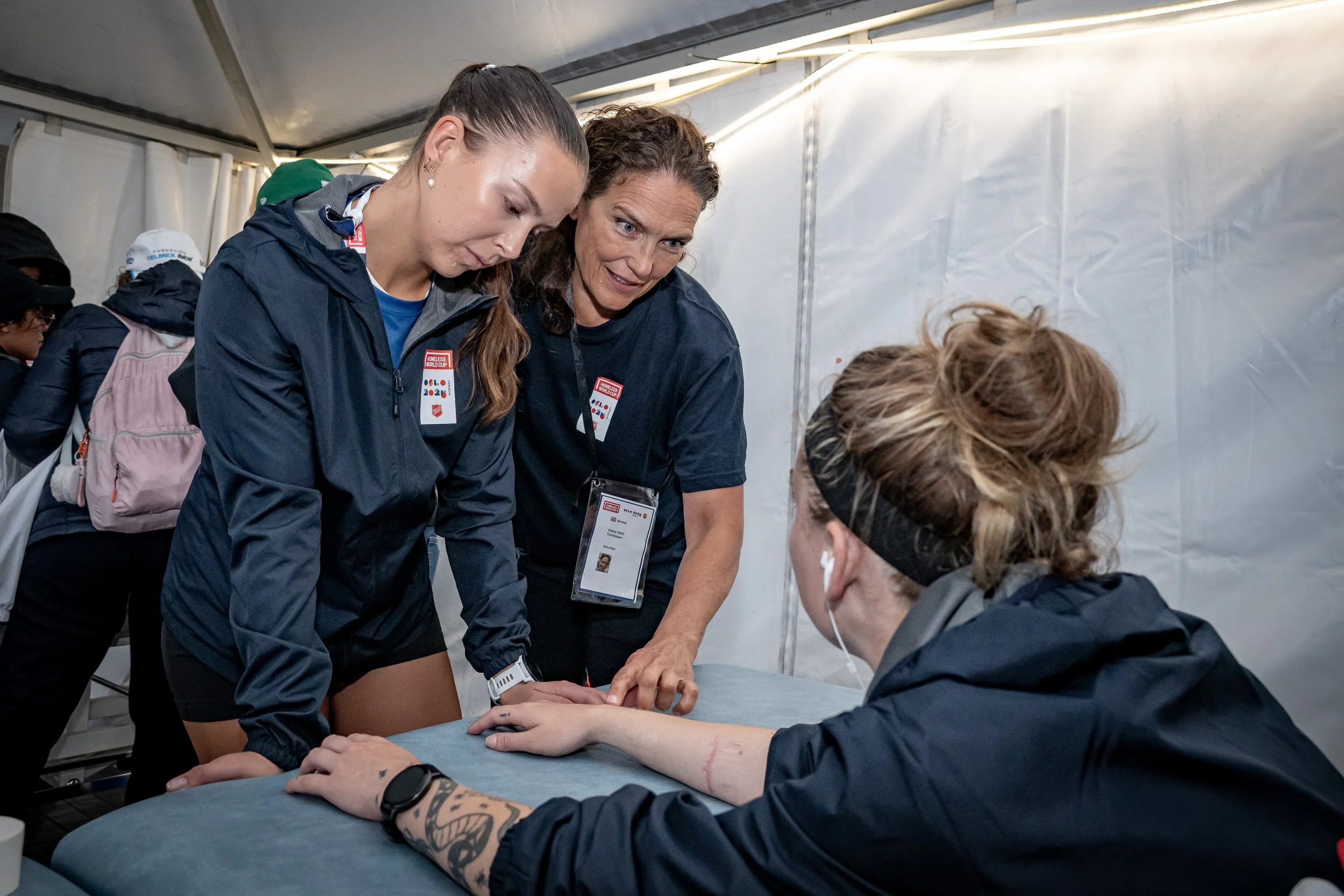
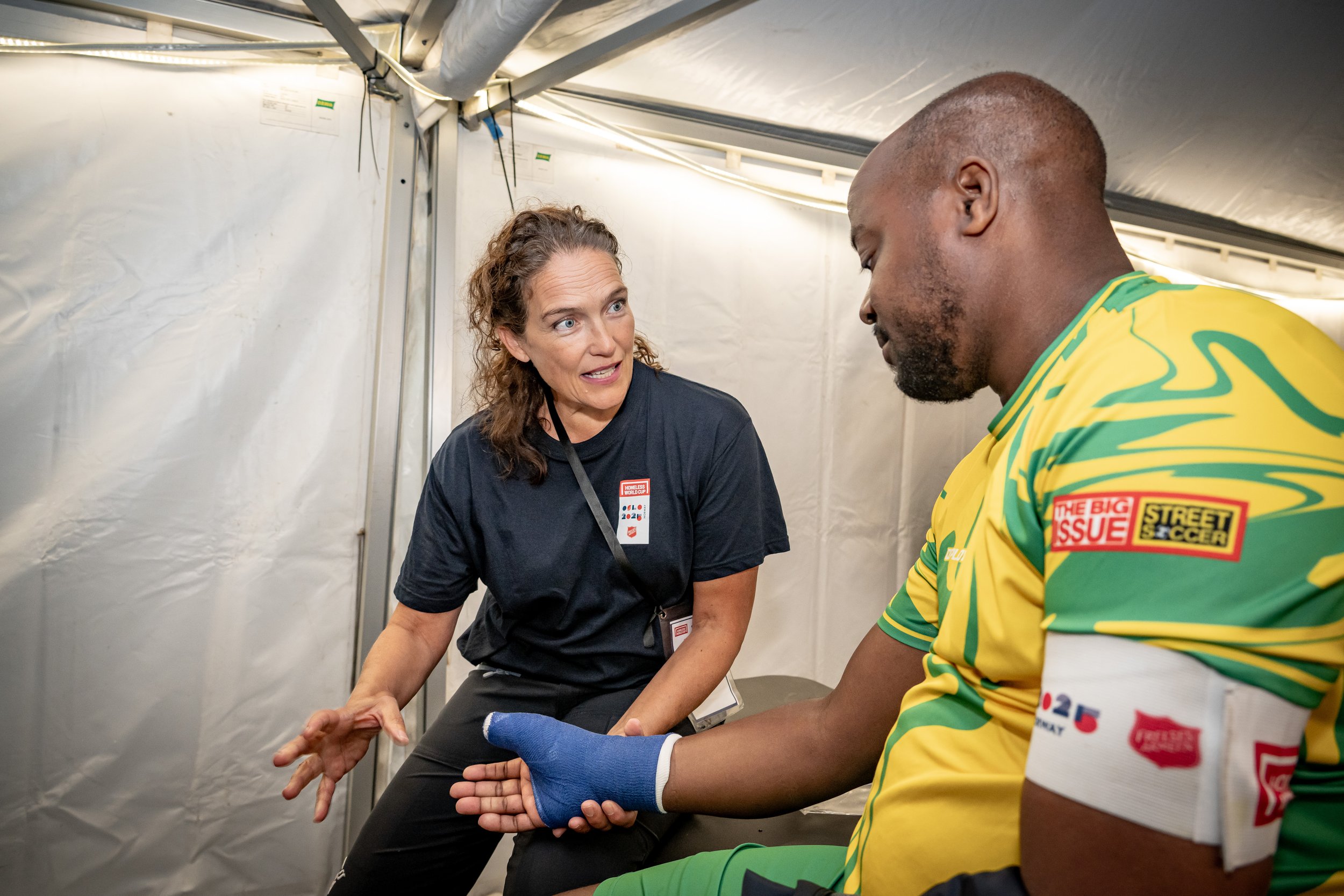
“It’s been interesting to do acute physiotherapy,” they tell me of the contact and non-contact injuries they’ve seen. “I thought it was going to be only ankles, but I’ve had all joints - shoulders, the hand, the hips, everything.” The hand injuries, for example, have come from stopping shots or simply from falling. (Also, the students treated two spectators who slipped on the wet ground amid some downpours).
It’s proven a double-edged sword. On the one hand, the students have gotten to encounter injuries that enhance their experience and expertise, but that has meant it was tournament over for somebody. Delivering hard news to someone can’t be pleasant. “Yeah, no more tournament,” they agree, shaking their heads. On the upside, those moments were few and far between and the students were pleasantly surprised that the injuries were comparatively fairly minimal compared with what they could have been. “We were expecting more injuries [as the weather turned inclement],” they tell me.
As part of their comprehensive checks and care, the students sent quite a few players to hospital, primarily to rule out or to confirm suspected tournament-ending injuries. “There have been some fractures and some ruptured ligaments and a few bad or really serious situations, but sometimes it’s just good to send them there and to be sure,” they explain. Players often returned the next day with their x-rays, so the students had the additional benefit of confirming that their diagnostic processes were spot on.
Of course, weather and injuries aside, the week stretched the students in a range of directions.
Some teams, already aware of the benefits physiotherapists offer, regularly availed the students of their services. Other teams, less familiar with the offerings or perhaps reticent to impose, visited less frequently, if at all. It was those teams to whom the students specifically provided some outreach. “At the beginning, we tried to reach out to everybody, talk to the coaches, the players, and tell what we can contribute,” the students explain. Also, it only takes one team member to break the ice: “If one or two of the team are coming, then it’s easier for the rest.”
Language and vulnerability added additional complexity.
The native Norwegian and Danish speakers conducted their work in English throughout the event, something that enabled them to both speak to each other but also help most people from most countries but that they acknowledged was starting to exhaust everyone’s brains by the week’s end. There were, however, a few countries for whom English didn’t bridge the gap. For those teams, they used Google Translate.
Trying to explain to someone via Google Translate that you need to manipulate a certain body part in order to determine injury posed some challenges given the intimacy of the kind of work physiotherapists do, especially as the people they were working may have been additionally vulnerable due to the circumstances that brought them to the tournament. For that reason, building rapport and taking the time to check for understanding was key.
“That’s why Google Translate is important, because when we have tested a joint, they need to know what we tested.” The students also tried to clearly explain the why of what they did. Also, to ensure the player understood what they found as part of their investigation, and whether that meant they could return to the pitch or if it meant the football-playing part of their tournament was over.
“You go through an assessment, examination, what you start with, what’s next up, and as well, what you end with, like telling the patients: What have I found out? What should you do further? … So, like, really tell them all the way through the assessment.”
It’s wholistic. “Treating the human in front of you,” they agree. “It’s about more than the need, it’s about the whole person we’re meeting. And that’s so important here, a lot of things that people are struggling with, it can be hard for them to connect to people in the first place, and then they come here with an injury as well. So really seeing the human behind [the injury].”
| Image: Anita Milas
Words by Fiona Crawford