
Think coach, think (fe)male
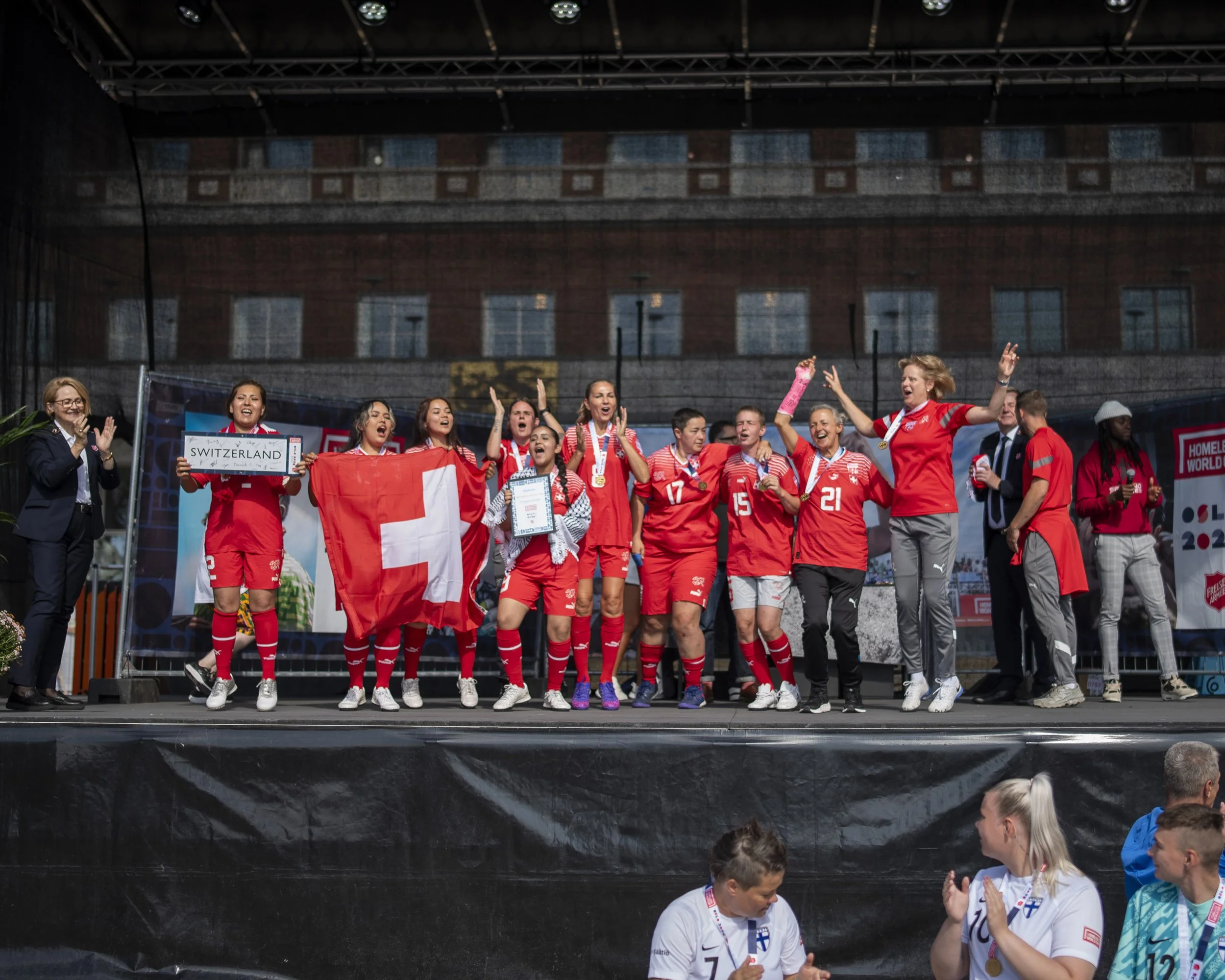
Carmen Peter celebrating with Switzerland Women’s team at the Oslo 2025 Homeless World Cup
The number of women football coaches around the world sits in the single to low double digits. Even at the highest women’s football level, national teams at Women’s World Cups, coaches comprise just over 30 percent.
Those low figures are underpinned by a range of factors—for example, lack of opportunity and entrenched cultural norms that privilege the patriarchy—but people and organisations around the world are slowly, steadily working to address them. Included in that incremental improvement and worth investigating and celebrating are the teams that attend the Homeless World Cup.
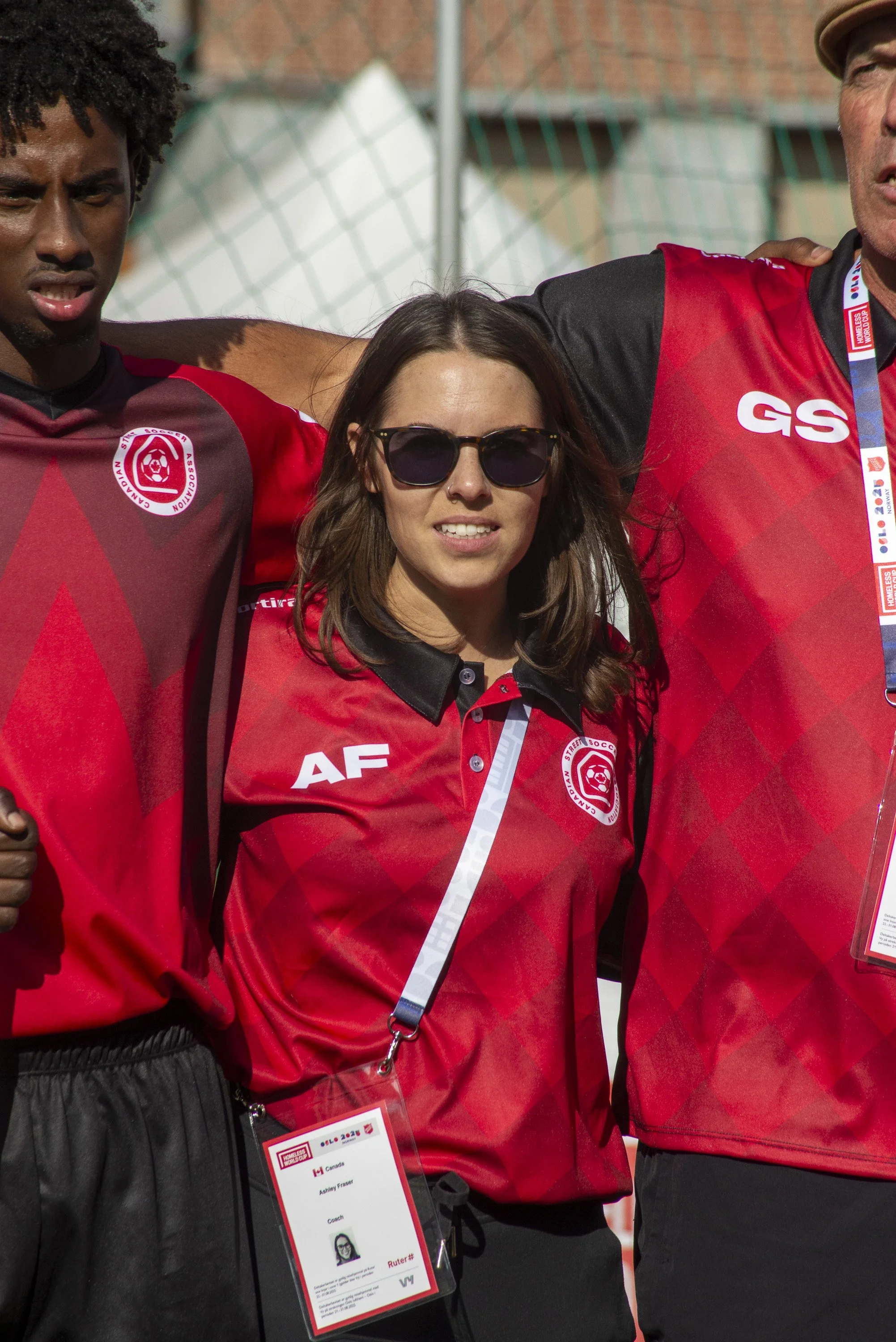
Ashley Fraser at the Oslo 2025 Homeless World Cup
The impetus for this story actually came from Canadian mixed team coach Ashley Fraser. Having coached the Canadian team at Mexico in 2012 before Canada took a hiatus and she took some time away to raise her family, Ashley returned as the mixed team coach with the re-established Canadian team in Oslo in 2025. This article was prompted by discussion around the Canadian team’s approach and meteoric growth in women’s sports and women coaches’ role in said sports more generally.
“I’m just proud of the Canadian Street Soccer Association really seeking out and promoting female leadership,” she explains. “It’s very in tune with Canada right now, because in Canada we just launched a female professional football league, the Northern Super League (NSL).”
She’s referencing the Canadian equivalent to the American National Women’s Soccer League (NWSL) or the Australian A-League Women’s. The NSL was launched by former Canadian national women’s team greats Diana Matheson and Christine Sinclair who have, along with their peers, broken new ground in terms of professionalism and pay and gender equality advancement.
But Ashley knows that, although we’ve made some huge inroads in recent years, there’s still a way to go. Case in point: women stepping beyond coaching women to also coaching mixed and men’s teams. “As a female coaching in a men’s league, it’s very apparent to me that I’m a female … I’m aware of the unusualness of it. It shouldn’t be, and it’s changing, but it’s still unique,” Ashley says.
She’s not wrong. There’s a challenge women face in football coaching positions all the way from amateur to professional leagues. Often, as Ashley herself has found, women coaches are mistaken for being support staff: think coach, think male is the default. It’s not confined to football. There are memes around women choosing lower-paying jobs in all industries. These jobs include womandoctor and womanCEO.
“I think just that diversity is so important. It always has been, but still, it’s 2025, and it’s funny, because it’s not that it’s a big thing, but it’s noticeable. I find that the men, they go to my [male] manager. It takes a minute for people to realise [I’m the coach], and even then, I feel like I’m having to assert a little bit to make people believe it. It’s not even intentional things. I think it’s just standard, right? What people are used to. So there’s still work to be done in terms of how women are respected in sport and how we get to show up in sport, and the Homeless World Cup is just another way to lead by example and show what that can look like.”
The Canadian team is embodying that. “I mean, they’re like, ‘We picked you for you. It was regardless of gender. We wanted you because of your previous experience.’ So I appreciate that.”
Indeed, Ashley, along with fellow coaches Mary Byrne and Carmen Peter also featured on the Homeless World Cup website, are explicitly and implicitly working to nudge coaching gender equality facts and figures in the right direction.
“I think it’s changing the perception that [gender shouldn’t be relevant]. If you have the ability to coach, the leadership, the heart, you can do it regardless of true who’s playing,” Ashley explains.
In many ways, that she’s contributing to this progress at the Homeless World Cup is fitting—the tournament is, after all, one that works to change perceptions one player, one team, and now one coach at a time. And for Ashley, with more than a decade’s gap between tournament attendances, it’s a tournament that feels like coming home. “Obviously it sucks you in. It’s a whirlwind, but it’s an addictive whirlwind,” she says of her street soccer and Homeless World Cup involvement. The best type of addictive whirlwind.
“When [co-founder] Hossam Khedr and others started [the Canadian street soccer program] again in 2024, it was actually Ed [Kiwanuka], because I coached Ed in 2012 in Mexico City. He reached out to me and said, ‘Hey, Canada is coming back. Are you in?’”
Ashley currently runs the Canadian street football program in her home city, Calgary, but didn’t think she’d be attending the 2025 Homeless World Cup as the Canadian team didn’t this time comprise any players from her program. “I just said, ‘I don’t need to go. Why would I go if I’m not sending a player?’ I kind of just took it out of the calendar. It was like, you know, there’ll be another year. Then Hossam emailed and asked if I’d coach, and I was like, Oh my God. My first thought was: I can’t do that. And my second thought was: Hell, yeah, I can do that.”
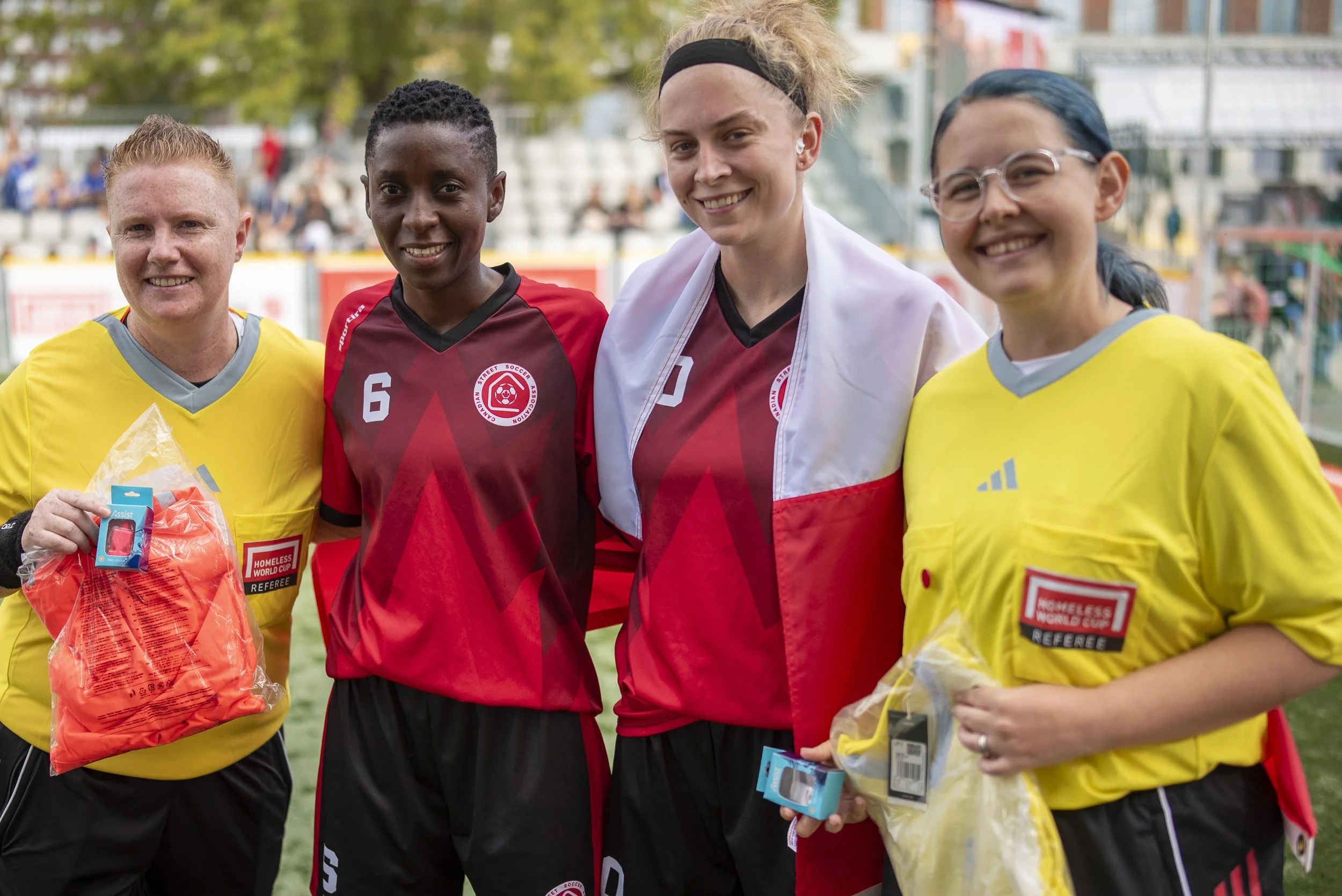
Canadian players with Sarah and Natalie from Wales who are part of our International Volunteer team and Homeless World Cup referees
She’s also getting to share the experience with others.
“My family came this time because when I went before I was young, in my 20s. I didn’t have my own family. So to have my husband and kids here, because now my kids are seeing it … I think that’s what’s so special this time is they’ve heard about it but now they get to experience it themselves.”
She’s also getting to relive it with people from her previous tournament experience.
“It’s all the full circle moments, having my kids here, being with Grant, who’s the manager, who I’ve known for 15 years through street soccer, being here with Ed again … I was at it with Ed when he was a player, and now he’s a ref[eree and Canadian street soccer co-founder] and an inspiration.”
It feels special to be experiencing it again firsthand.
“I think the movie, The Beautiful Game, did such a good job. But it just showed a glimpse of it, you know? When I watched it with my family, I was trying to explain that the film doesn’t even do it full justice. You just can’t experience … you just don’t know it until you’re here, until you’re hearing from the players the things that come out of their mouths in terms of ‘This feels like home’ or ‘I have hope now’. It’s things that you can’t make up, to see where players, like with Ed, to see where he’s gone, it’s a decade of growth.”
It’s life-changing for players, coaches, and supporters alike.
“My toddler’s three and a half, and then my older boys are 11 and 13. So they come and play, and they’ve got to know the team here, and that’s been special, because we just feel like one big family here. I feel like they just got eight new brothers and sisters being in the tournament this week, which is really special.”
Also, what an example she’s giving them: how kick-ass a mum can actually be.
Ashley’s taking plenty from the experience, too. “We sat around yesterday and we just talked about what we’ve learned here so far off the pitch, what we can bring home. I shared with them too. I said, ‘I know you guys are showing up every day and you’re pushing yourselves.’ I said, ‘I’m pushing myself too. I’m showing up every day and I have to assert myself as a female coach and push myself.’ So it’s not just growth for players—I think everyone here grows and learns.”
Like Ashley, Ireland coach Mary Byrne is one of the tournament’s increasing number of women coaches, and she has the hard-won privilege of getting to witness and support Ireland players through the Homeless World Cup each year.
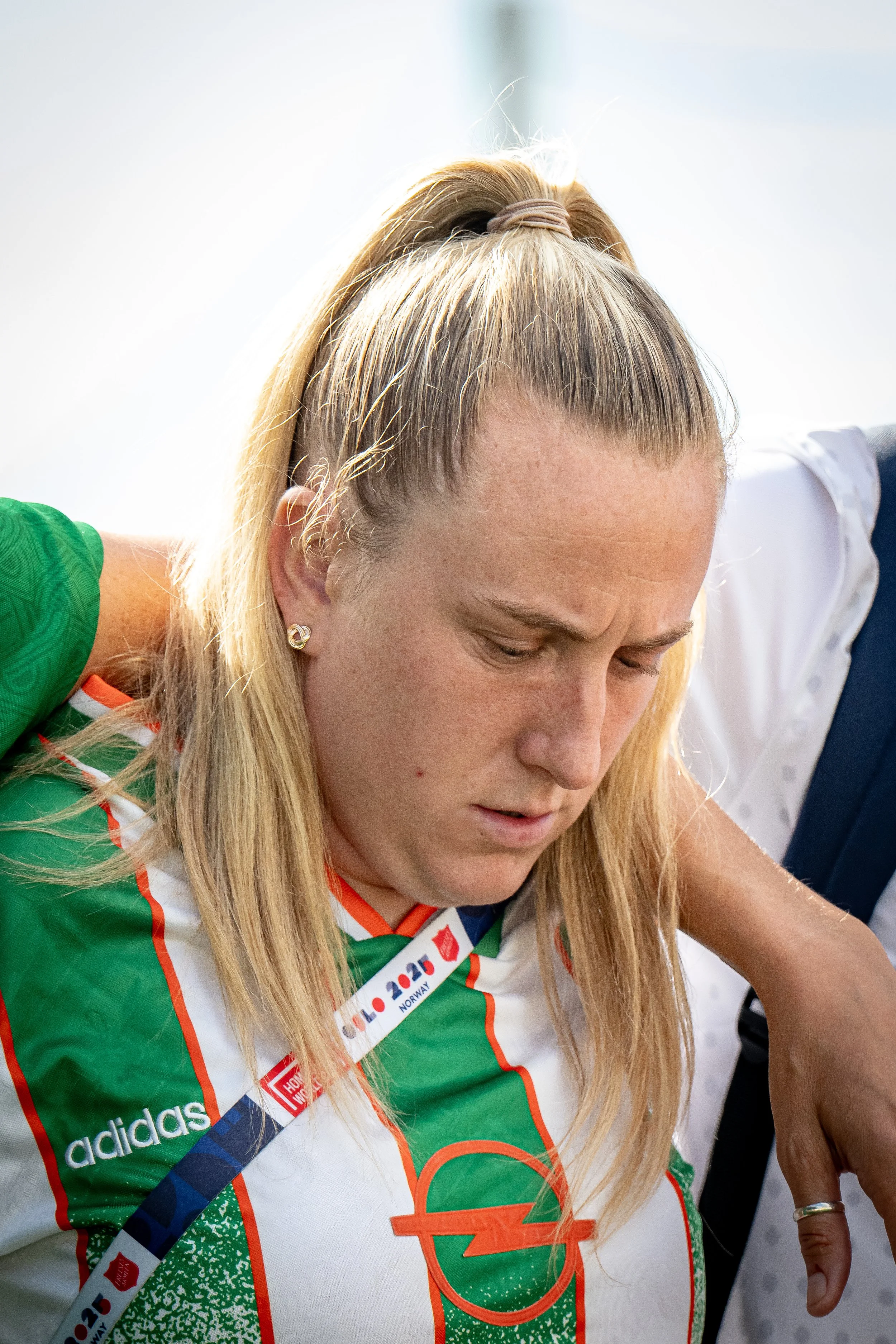
Ireland coach Mary Byrne
“I think it’s deadly. I absolutely love it. I love seeing the players grow in confidence over at the tournament. I love seeing like families getting in contact with them that they haven’t spoken to in ages. I love just the emotional experience of it, of how they realise when they get here … They come over here this year, and they’re like, ‘We thought [last year’s players] were bigging it up.’ Then they get here, and they’re like, ‘They were not even bigging it up enough,’” she laughs.
Mary’s witnessing the impact unfold in real time.
“They couldn’t understand until they actually got here, the experience … no one wants to go home. I love seeing them enjoy it. It’s emotional. When you know some of the, some of the stories …” She references a player who came through one of their prison programs. “She’s done a full circle, she got out of prison, went into recovery, ended up coming down, and now she’s here with us. I just be in tears thinking about her.”
Mary has some empathy for the players’ experiences—she’s the Ireland women’s team’s coach but could also have qualified to play as she had experience of homelessness growing up with her family in Dublin. Her father had experienced alcohol addiction that had had implications for the family as a whole.
“[My father] was sober a long, long time before we were even born. Then it was kind of always, you know, when you’re kind of brought up that way you know about it, you have kind of the understanding or the respect for it.” She joined the street football program where she met player turned coach and social worker Graham Tucker. “Me and Tucker get on very, very well. He took me under his wing. I started playing with the boys, and then got into coaching.” The two have been coaching together and supporting each other ever since.
Regardless of gender, there’s plenty of invisible grind and hard work that goes into the coaching role, particularly as it requires turning up regardless of weather week in, week out. “Especially standing down in the lashing of rain, but that’s what it’s about,’ Mary agrees, but then points to a memorable moment with a player. “When he first came out with recovery to where he is now, you wouldn’t even believe it’s the same young fellow. He’d never say it, but he wouldn’t come down on his own. He’d always want to come with someone.”
She recalls one really rainy Saturday when unexpectedly he ventured down solo—the weather may have discouraged his friends, but not him. “You’re like, he needs that, you know what I mean?” Mary explains. “Then he’s saying, ‘Oh, if there’s not enough lads down, I’ll just stay and play with the girls or kick a ball outside on [my] own and have a chat.’ [It reminded me that] it’s important to be there for those weeks as well, because these people need the support every week to come down.”
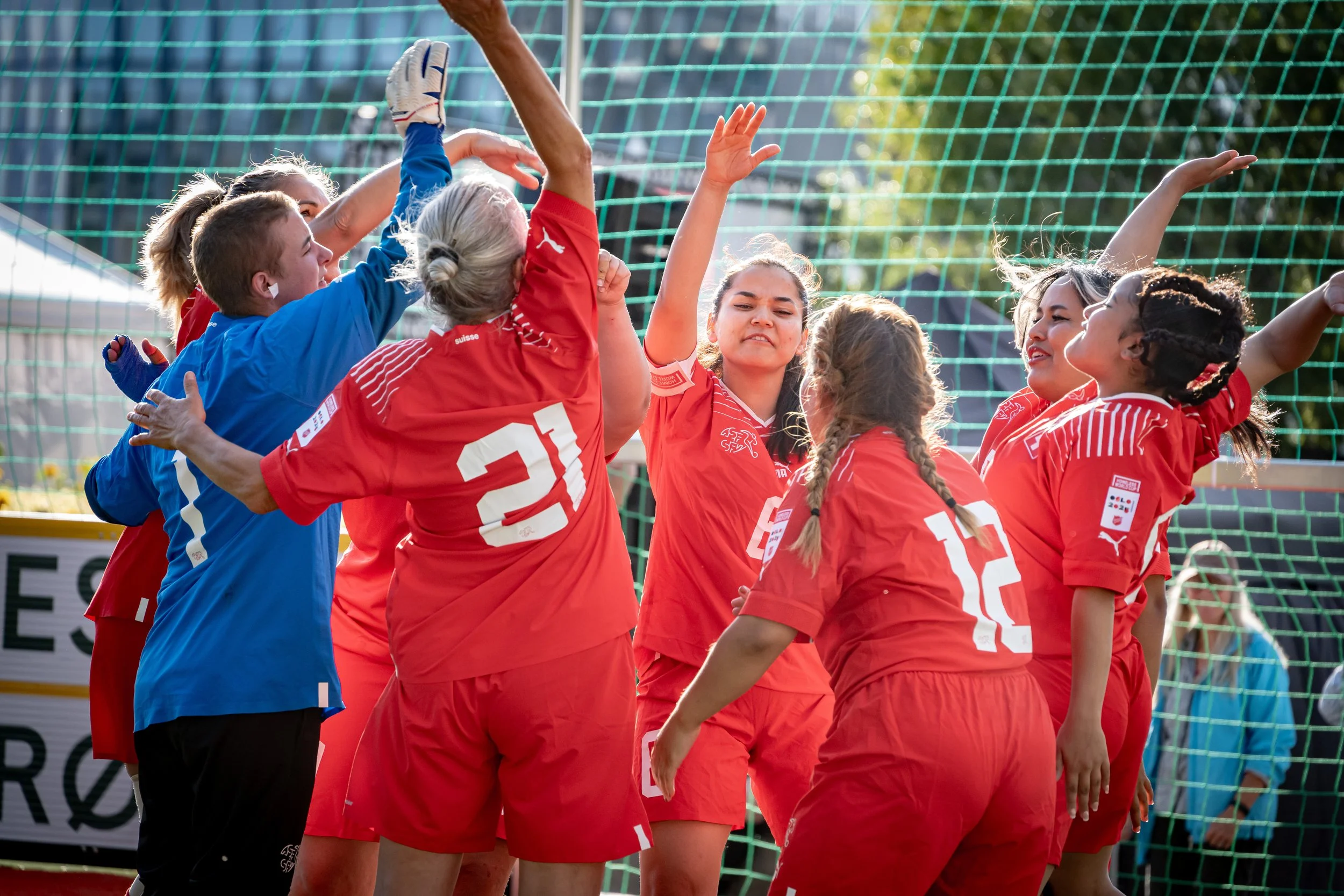
Switzerland Women at the Oslo 2025 Homeless World Cup
That commitment level—and the mental load that comes with it—is something familiar to Switzerland women’s coach Carmen Peter. “A coach’s mind is never at rest,” Carmen says. “Almost always my head was thinking about the team in this two weeks. We started with a training camp in Switzerland the Sunday before, then we came here directly to Oslo, so we were together for two weeks.”
Part of that full-mindedness is because coaches are always having to problem solve and adapt. “Our goalkeeper was injured in the week before we came so we had to choose a field player,” Carmen explains. “Now we have three injured, one broken arm, two times the fingers …”
The upside—a reframe—is that the injury adjustments have provided a learning opportunity. “That’s also one instance where the team can grow together, because somebody has to go in goal. Often a field player does. They don’t like it, but they did it so well. After the three injuries we had only one field player left who could do the goalkeeper job. She did it incredibly good, I was very proud of her. She kind of grew into it.”
Carmen has attended the Homeless World Cup in Sacramento with the mixed team, but this was second time as the coach with the women’s. (Switzerland brought a women’s team for the first time to the 2024 tournament in Seoul.) Her involvement with street football and the Homeless World Cup came via a friend who invited her to break her football hiatus. “I played for 20 years, and then I had a break of 20 years. A friend of mine told me that the organisation in Switzerland was looking for a women’s coach. I had a look there, and I liked it very much. The players, the staff, the way how they work—I fell in love with this project. That’s five years ago,” she says.
Carmen’s sought to develop Switzerland’s women’s program in that time, culminating in establishing and sustaining a women’s Homeless World Cup team. Like anything, it wasn’t straightforward.
“We started to build it up and to let it grow. The first tournament [the women’s team played] was in Utrecht in the Netherlands, Europe. Then COVID hit, so there was a break. But we didn’t stand still. We organised a small tournament with Austria and Germany together in Switzerland called the Alpine Cup. We tried to keep the league in this difficult time.”
They persevered through the remainder of COVID and with the awareness that worldwide there are greater challenges in recruiting women to football programs. “This one is lightly growing. We are [currently sitting at] about 40 women [participants]. We always try to get more, but it’s not that easy.” Still, it’s now large enough and sustainable enough for Switzerland to field a full women’s team for two consecutive years and hopefully ongoing.
Of overcoming the hesitancy women feel in joining street football, as a woman coach in a space that she understands can be male-dominated and intimidating for women to enter, Carmen also tells prospective players, “Sometimes you have to be motivated or just to do the first step. It’s difficult, but I will tell all the people, ‘Do this first step, come and have a look and feel these really good vibrations here and so that we can get a huge community.’ So everybody is a little piece of it, and that’s very nice, that makes us strong and being together really meaningful.”
That community and meaningfulness is building. Some of the 2024 players are now acting as ambassadors and recruiters and coaches of sorts—a non-threatening success story to help bridge the interest-to-participation gap. “Now all these women who played for Switzerland, they stand for the team and they can support by asking others: ‘Hey, you want to …?’ and so on. They still are involved in the whole thing. That’s very important, and they love to be with us. We had, for example, one player from last year, she cooked together with another player for us in our training camp. So it’s so nice. She has also visited us. She came over to Oslo as a fan.” Through the Homeless World Cup we have a history with the players, that connects and no one can take that away.”
Another player’s contribution also doesn’t stop there. “She went on to build a team in her home region that everybody can join.” So she’s a player turned organiser–coach. This one of the reason, why this project is so valuable.”