
Norway: The novel solution to addressing women’s homelessness and addiction in Bergen
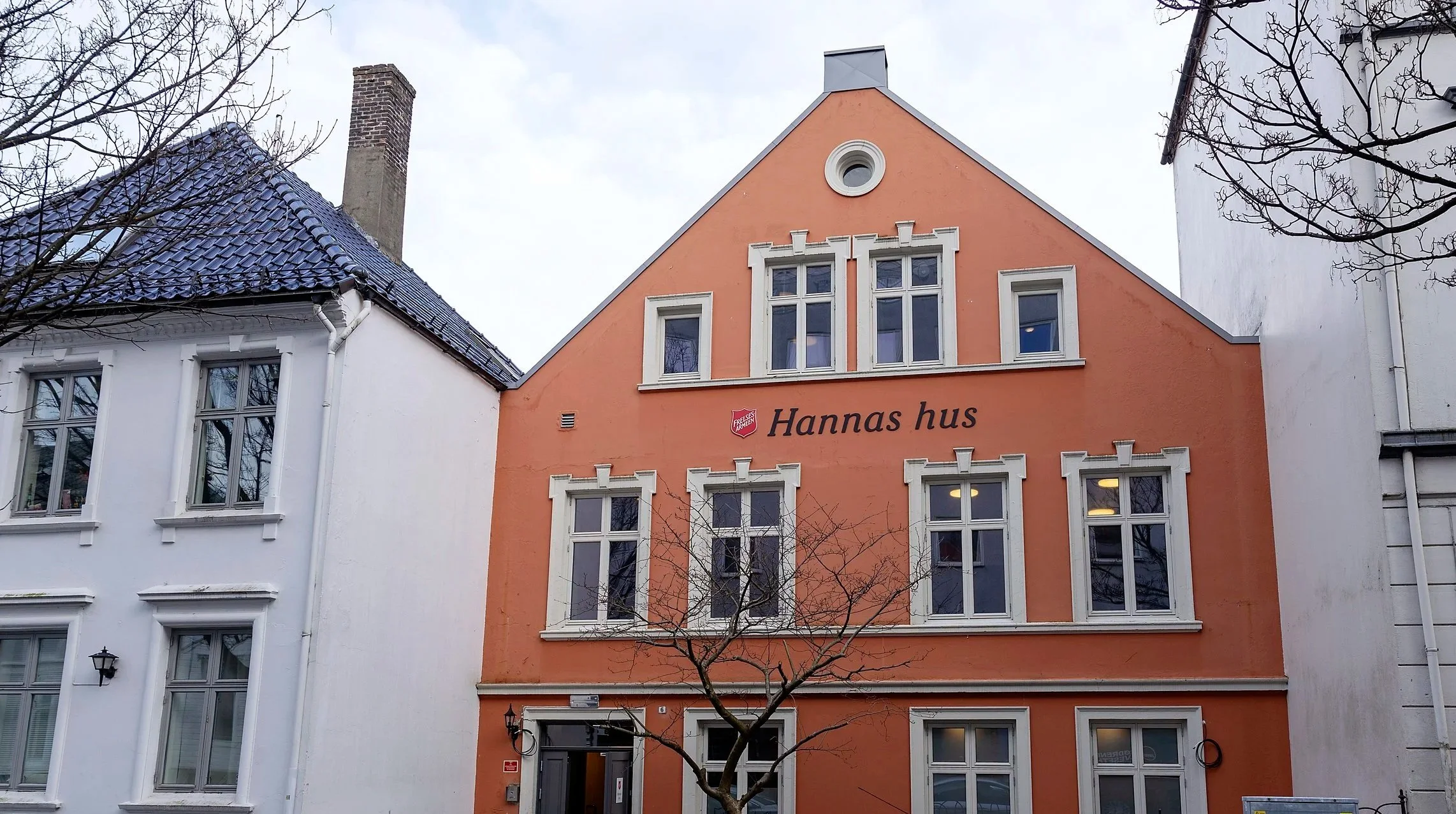
Hannas House. Image Credit: Salvation Army
Sometimes the solution is right in front of you—or, in the case of Hanna’s Hus, right next door. The Bergen-based accommodation run by the Norwegian Salvation Army designed to help women experiencing the dual challenges of homelessness and drug and alcohol addiction came about to address an important issue, and was realised through opportune timing and geography.
The Bergen local government had identified the urgent need to create a women’s shelter because women are incredibly vulnerable in the active drug community and there weren’t at the time services in the area that could adequately provide this much-needed support. The government sent out an invitation to tender, and the Norwegian Salvation Army, known as Frelsesarmeen, submitted what would become the successful bid. The Frelsesarmeen team were trying to envisage how to make their bid a reality. Space was, as always, the challenge, and the Frelsesarmeen staff considered all possibilities for where they could build a women’s shelter. That even included surmising if it might be possible to build a shelter above the staff laundry area in their existing premises at number seven on Bergen’s Bakkegaten.
Coincidentally, at the time they were investigating options the premises next door came up for sale. Looking at the premises out of their office window, they felt an urgency: we need to buy those premises and deliver on the local government’s request. Less than a week after submitting a formal tender, and with the encouragement of the Bergen local government, number six was theirs and Hanna’s Hus was on its way to becoming a reality.
Named in honour of Hanna Ouchterlony, the woman who brought the Salvation Army to Norway almost 130 years ago, the Hanna in Hanna’s Hus carries a dual meaning—the word fittingly means ‘grace’. That is, the supportive approach Hanna’s Hus takes to help women transition out of homelessness and addiction.
The Salvation Army has a saying that ‘we do what we can, not what we must’. That was the principle with which they approached Hanna’s Hus. Far exceeding the minimum requirements to provide women experiencing addiction and homelessness a safe, warm bed and one hot meal a day, the team work to help people escape homelessness not just temporarily but long term.
For this reason, the Hanna’s Hus premises have been fitted out to feel more like a home than a shelter.
We made it much more than needed because we think that the environment helps the peace and relationships,” Hanna’s Hus Program Manager Ann Kristin Åkerlund Riise explains.
We want to do as much as we can within the limits, of course, of what we have.” With this in mind, the thoughtfully renovated interior is painted a calming, deep teal blue, and the premises are furnished with artworks and comfortable furniture. The house has a terrace and back-yard to facilitate time in green spaces, too.
The women-specific Hanna’s Hus is situated across the street from mixed-sex accom-modation. The single-sex approach was deliberate. Many of Hanna’s Hus’s residents have experienced trauma through intimate partner violence or sex work undertaken to support drug and/or alcohol addiction—experiences that have left them vulnerable to exploitation and to experiencing relationship difficulties. The single-sex environment helps the women feel safe and focus solely on their recovery.
“I guess it is the safety without being re-traumatised with men. Also, if you have been in a lot of violent relationships, if you have been a sex worker, then it’s hard to stop doing what you already do. We are humans of habits, the way we do it is the way we do it. To have this place where you don’t have to meet men, you don’t have to see those... So it’s safer, and calm,” says Irene Angelskår, who provides support in Hanna’s Hus.
Hanna’s Hus can house six women and provide an additional two crisis accommodation beds at any one time. Again, based on the principle of doing what they can, not what they must, the Salvation Army set out to innovate in the services Hanna’s Hus could offer. Subsequently, Hanna’s Hus provides three accommodation levels within the storied building, with each level providing a different housing space and tier of support.
The first level provides overnight crisis accommodation for women with drug and/or alcohol addiction who have had to leave accommodation suddenly or who have found themselves without somewhere safe to stay. There are two rooms on this level that are made available at 7pm each night and vacated at 9:15am the following day.
The second level is more akin to a dormitory, with rooms adjoining a communal lounge and kitchen space. The idea is that it offers a staggered reintegration into co-operation and living with others. Four women can live there at any time.
The third level has two self-contained apartments that allow the residents greater agency and autonomy, enabling them to practise living independently in a supported environment before graduating into the world. “It’s a perfect place to see: How do you function with all this responsibility?” Angelskår explains. (The answer is: often well. One successful transition Angelskår recalls relates to a woman who, having graduated from the third housing level, now has her own apartment. “But this is the best part: she has the relationship back with her grown-up child.”)
There is no curfew at Hanna’s Hus. The residents can come and go as needed while living there, and they often do. The Hanna’s Hus staff also work to connect women with other local government, healthcare, and employment services. Some of the women have found employment in local job programs, which include paid work for cleaning and litter collection at private premises and for the municipality.
The Hanna’s Hus residents also attend rehabilitation meetings, counselling, and provide much of their own food, although Hanna’s Hus provides one meal—dinner—each day and has some emergency provisions to ensure no one goes hungry. (As Angelskår acknowledges, sometimes the social anxiety of venturing out to buy food can be as difficult to grapple with as not being able to afford to buy food. Some critics may argue that the residents are often capable of going out to buy drugs. “Yes,” Angelskår says, “but for the women who are addicted, drugs are in some ways medication.”) In large part, the women residents are self-sufficient, buying and cooking their own food, sometimes sharing the cooking responsibilities to reduce the workload and build community.
One stipulated Hanna’s Hus rule is that staff open the door for the residents, whether they are entering or exiting. It facilitates an informal welfare check and builds trust and relationships. “It’s a lot about running and opening and closing the door and to have conversations,” Angelskår says of what her workday entails.
One of the other rules is that the women who are living on the second floor are not allowed to enter the third floor without permission, and they can only visit the space at invitation during the day. That allows for some privacy for the third-floor residents, but it also makes the space additionally special. (The women take great pride in keeping the nice new space beautiful, too. “You don’t want to destroy it. You want to keep the place nice,” Angelskår says.)
The residents can alternatively gather in the second story living room to watch television together—something that takes concerted effort and care. “When you are living on the street and you use drugs, there are more men than there are women and with the women the fight is about keeping your man if you have a safe man…”
Angelskår explains. “Many of the women have also been in this kind of competition game with each other, and then they are supposed to live side by side. It’s a whole lot of training, social training, living like this. I have said to some of the women on the second floor, I don’t think I would have been able to. So what you are doing, this is really, really awesome.”
Also, seeing other women experiencing addiction and social integration challenges can be confronting—like holding a mirror up to their own circumstances. “So they are brave. I really do believe that our women are brave.”
Angelskår brings her own level of understanding and bravery to this work. One of approximately 20 staff who work closely in a generous round-the-clock staff-to-resident ratio, she brings not just training in such practices as personal responsibility-based Gestalt and trauma therapy expertise to her role, but also lived experience, having also experienced drug addiction. It was a difficult addiction to break, especially as some of the aspects of drug use provided initial uplift. “You receive positive feedback from the society because you have some drugs that make you act more interested and interesting,” Angelskår says. In short: “It gives you a release from the trauma, but then it becomes your prison.”
Like the fortuitous timing and vision that saw the Frelsesarmeen obtain the Hanna’s Hus premises, Angelskår came to Hanna’s Hus through a career vision. For some years, Angelskår had worked in day-time venues that provided meals and healthcare support, but knew Hanna’s Hus was for her when she heard it was starting up. “[My previous workplace] was also a place we had a lot of users. There were both sexes, and there could be episodes of violence. I saw the women, and I felt for the women. So I had this dream of working [solely] with drug-addicted women,” Angelskår explains. “I saw that they were building Hanna’s Hus and trying to hire people and I spent time updating my resume to make it the best I could. I thought: ‘I really want this job, and I think I could do a good job of it.’”
Angelskår is open and transparent around her own challenges, which enables her to meet residents where they’re at. “I still struggle and I’m honest about that. I don’t pretend. I’m still struggling, and I do understand that [some residents] might not even want to be sober or stop using drugs.” Angelskår explains that everyone’s reason for interacting with drugs is personal, but the bedrock issues and experiences are universally recognisable. “I speak very openly of my own experience. And when I do that with our [residents], we always recognise not the story but the drive …”
In recognising that drive and the complexity of overcoming addiction, Angelskår and her peers mostly provide residents with the non-judgemental curiosity and grace of Hanna’s Hus’s namesake.
It’s like I see you and I want to help you and I also accept and believe that you are in control and I want to give you this control and I will praise you for you are doing so good.
These are really wise women, these women. Many people say, ‘I want to work with drug addicts because I feel so sorry for them.’ No, no. These women are strong. They have survived. They are smart, reflective, and they have depth and philosophy, and we have so much to learn from them.”
She adds: “They have also a lot to learn from us, but they can choose. We can’t choose the level. It’s we who have to meet them in their world. We stretch ourselves to meet them in their world.”
She continues: “I think the most important thing we do is that we give them trust. We believe in them… We are available, but we don’t need to interact. If they want to live in a room and have the full responsibility for how they cook and how they want their food, we don’t need to say anything more to them than just—actually, we don’t have to say anything. We can open the door and we can close the door and we can smile. I think this is one of the most important things that we do.”
In touching on the same theme, Åkerlund Riise references the lyrics from the Norwegian song ‘Skyfri himmel’ by Bjørn Eidsvåg, which translates to ‘the sky without clouds’. The lyrics were read out at the Hanna’s Hus opening and informs the Hanna’s Hus staff’s actions and interactions as they seek to provide Hanna’s Hus residents with opportunities to have as many moments of cloudlessness as possible.
Words: Fred Crawford