
The Long Road

Seyedullah in action for Greece at the Oslo 2025 Homeless World Cup
Image: Donnie Nicholson
Gift a Seat This Christmas
This festive season, we’re celebrating the heart of the Homeless World Cup: the 500 players from the Oslo 2025 Homeless World Cup whose courage, resilience and joy in August of this year, continue to inspire us every single day.
From the 13th December until the 24th December, we’re sharing The 12 Stories of Oslo 2025, a journey through uplifting, powerful accounts from the 20th edition of the Homeless World Cup which was held in Norway’s capital city this August.
meet seyedullah and mohsen
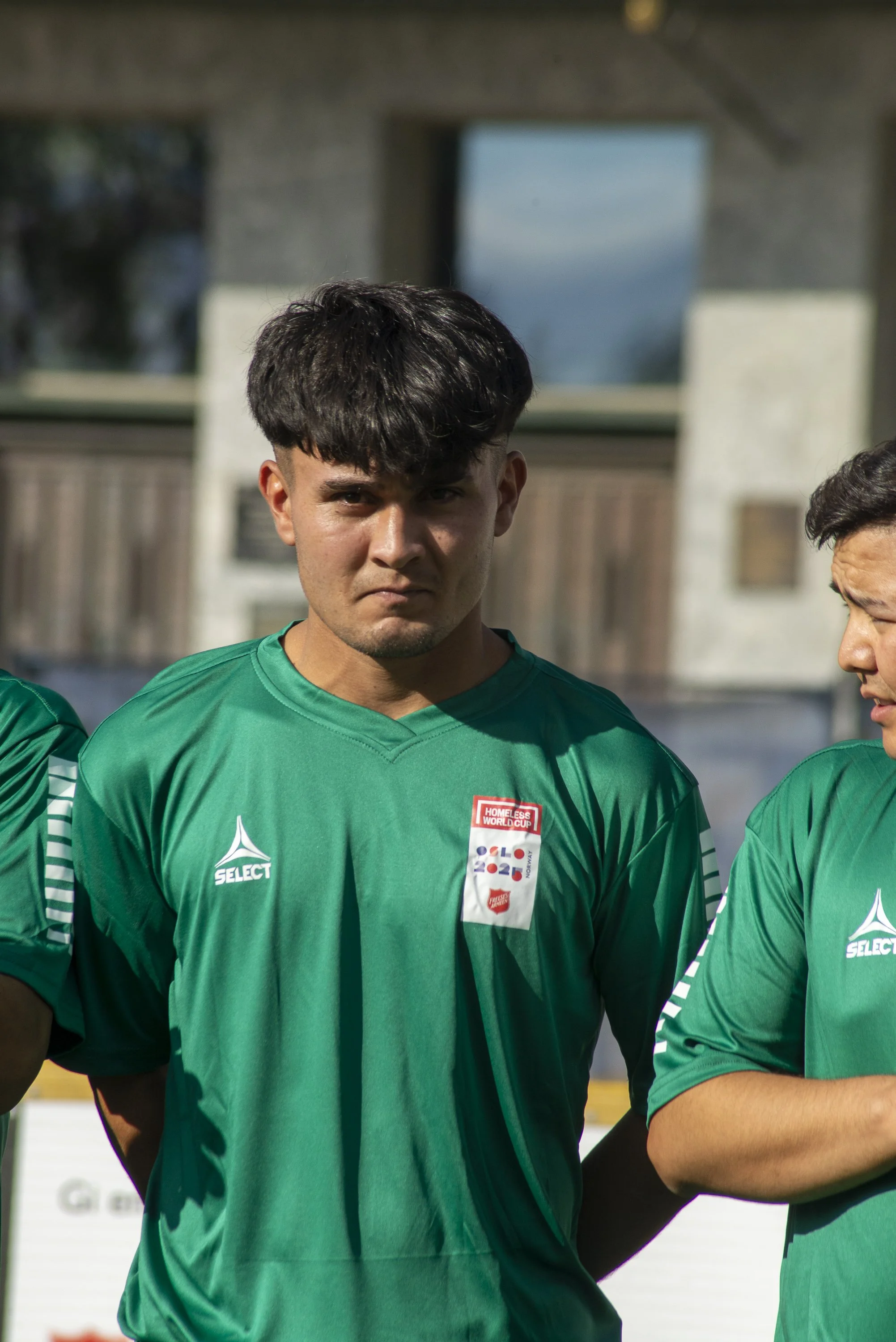
Sometimes people’s experiences of homelessness and marginalisation require you to sit back a moment to properly comprehend them. Hearing that the person translating for the player has a story that mirrors the player’s almost incomprehensible experience takes an additional few moments to process. Two players, with two very similar trajectories years apart, crossed paths at the Oslo 2025 Homeless World Cup.
2025 Greece Homeless World Cup player Seyedullah Bekzade walked from his home in Afghanistan to Greece when he was aged just 12. We know this because a former Homeless World Cup player and Afghan national translated his story for him. At the 2025 tournament, a call went out to see if there was a Farsi speaker available to translate a player’s story into English. In true Homeless World Cup tradition, Farsi-speaking Mohsen Zahedi, a player who represented Austria at the 2019 Homeless World Cup in Wales, answered the call.
Hazara in heritage and aware there wasn’t a safe, stable future for him as a member of a marginalised community in Afghanistan, Mohsen Zahedi’s story is almost identical to the story of the player’s he was to translate. Years before, he’d completed the treacherous journey from Iran, where his parents had moved his family for safety when Mohsen was 2 or 3 years old, to seek asylum in Europe. Having represented his adopted home country of Austria at the Cardiff 2019 Homeless World Cup held, he’d returned to the 2025 tournament in nearby Oslo to support the 2025 Austrian team. That included cheering the team on and taking some photos and, it turns out, supporting a current-generation player with some translation.
Uzbek in familial origin and determined to become a professional footballer, Seyedullah, the now-17-year-old player for whom Mohsen translated, understood even at the formative age of 12 that there was no possibility of realising his footballing dream in a country absent professional football structures and torn by war.
A Barcelona fan, he started to play football in his local area, but didn’t have money or access to buy footballs so had to make them out of plastic bags. There wasn’t a football tournament for him to participate in either, so he played football with his friends in the streets while dreaming of a much bigger, much greater football goal.
Seyedullah’s Uzbek heritage also narrowed his educational and work opportunities in Afghanistan. So, knowing there was little to no future for him in the country, he spoke to his parents about leaving. His parents were understandably worried but pragmatic and supportive.
So started a months-long journey comprising walking and catching public transport to seek asylum and a better (and hopefully football-filled) future in Europe. The path Seyedullah took, mostly on foot and supplemented by the occasional bus ride, involved treacherous travels over mountains and through deserted landscapes and dangerous countries whose perimeters are guarded by armed checkpoints.
First, Seyedullah travelled to neighbouring Iran. From there, he went to Turkey. Given he didn’t have any official paperwork, in Turkey he had to hide in a basement for months to try to avoid detection. He knew that if he were caught he would be sent back to Afghanistan.
That Damocles’ sword was the impetus for him travelling further, eventually landing in Greece. It also marked the restart of his footballing journey. “He was in a camp, and he was looking for a team to play football with. He didn’t know about the Greek Homeless World Cup team. You have to pay to be able to participate in the teams there. But this one was free so that was the opportunity,” Mohsen explains.
Seyedullah is hoping that, after this tournament, he can get into a semi-professional or professional team so he can pursue his footballing dream. In the interim, his family has been following his Homeless World Cup experience. “He has contact with his family. He already told them that he’s playing here in Norway, and they’re really happy to support him,” Mohsen explains. “They also say that he should pursue his dream and play football, and to continue with his school.”
Like any parent, they advocate having a fallback plan. With good reason. At 17, Seyedullah’s technically still a child, but the complexity of his circumstances are set to ramp up again shortly when he turns 18. “When you’re adult, you have to pay for rent, and it’s going to be expensive. So he’s going to have to work,” Mohsen explains. “[That means] he doesn’t have that much time. He’s just hoping that he can find a good team that he can play with [and pursue his professional football dream].”

Words by Fiona Crawford